
PDF417 Barcode: Definition, Structure, Advantages, and Applications
In the digital era of data processing and modern information management, barcodes are no longer just a simple string of symbols—they have become strategic tools for identification, traceability, and information security.
Among them, PDF417, known as the “data encoding expert” in the world of barcodes, stands out due to its exceptional data capacity and high reliability. From national ID cards and driver’s licenses to the boarding passes you hold before every flight, PDF417 is the 2D barcode quietly powering millions of critical data processes.
This article iCheckQR will provide you with a comprehensive understanding of PDF417—from its structure and advantages to practical applications and how to generate the code effectively using iCheckQR.
1. What is a PDF417 Barcode?
Definition and Origin
It was developed by Symbol Technologies in 1991 to meet the demand for more flexible and secure data storage in personal identification and information management applications.
Meaning of the Name "PDF417"
Presented as bullet points or a simple infographic:
PDF stands for "Portable Data File", emphasizing its role as a mobile data container.
417 refers to the barcode’s structure:
4 bars and spaces
17 modules (unit blocks) per codeword
 2. Structure of the PDF417 Barcode
Basic Composition
The PDF417 barcode is composed of several structural elements that enable precise positioning and data encoding:
Quiet Zone: This is the empty space surrounding the barcode. It contains no data and helps scanners identify the start and end of the barcode. Minimum requirement: at least twice the width of the narrowest bar.
Start/Stop Patterns: Special symbols located at the beginning and end of each row, used to define the boundaries of the encoded data.
Left & Right Row Indicators: Vertical columns on either side of the barcode that carry information regarding row positioning, structure, and data length.
Data Codewords: Each row contains a sequence of "codewords"—the basic units of encoded data, typically representing 1–2 characters each. The data is divided into binary codes and arranged in rows for efficient storage.
Error Correction Codewords (Reed-Solomon): These allow for detection and recovery of data in case of corruption or poor print quality, using the Reed-Solomon algorithm. Depending on configuration, 2 to 512 error correction codewords can be added.
Technical Specifications Explained
Customizable Rows and Columns
Rows: 3 to 90
Columns: 1 to 30
Increasing rows enables more data storage; increasing columns optimizes horizontal space.
Barcode Size Adjustability
Can be expanded or scaled down to fit actual print dimensions.
Still guarantees accurate scanner readability.
 3. Technical Specifications of the PDF417 Barcode
Data Storage Capacity
PDF417 offers superior data storage compared to traditional barcodes:
Up to 1.1 KB of binary data (~1,120 bytes)
Over 1,800 text characters (depending on character types and configuration)
Supports encoding of both standard ASCII (0–127) and extended ASCII (128–255) character sets, allowing flexible encoding of various languages and data formats.
Robust Error Correction Capability
PDF417 utilizes the Reed-Solomon error correction algorithm—one of the most effective error-handling techniques available today.
Can recover data even when up to 30% of the barcode area is damaged, blurred, or degraded.
Error correction level is customizable, with 9 to 512 error correction codewords available depending on the desired level of redundancy.
Specification Table
To better understand how data encoding works in practice, you can try generating a barcode directly using an online barcode generator and explore the storage capacity of different formats.
4. Advantages and Limitations of the PDF417 Barcode
Advantages
PDF417 offers a range of technical strengths and real-world applications:
High Data Storage Capacity: Capable of encoding up to 1,100 bytes of binary data or over 1,800 text characters, surpassing traditional barcodes and even many other 2D barcode types.
Royalty-Free and Open Format: PDF417 is an open standard that requires no commercial licensing, making it ideal for public systems, government applications, and enterprise use.
Strong Error Correction: With the Reed-Solomon algorithm, PDF417 can recover data even when parts of the barcode are blurred, scratched, or misaligned, ensuring high reliability in harsh environments.
 Limitations
Despite its many benefits, PDF417 has a few limitations to consider:
Larger Physical Size: Compared to QR Codes or DataMatrix codes, PDF417 requires more print space, especially when storing large amounts of data.
Requires 2D-Capable Scanners: It cannot be read by traditional 1D scanners and requires an imager or dedicated 2D scanning device.
Comparison with Other Barcode Types
Note:
QR Code supports error correction levels from 7% to 30% depending on the chosen level.
DataMatrix can be printed in extremely small sizes, making it suitable for tiny components or space-constrained packaging.
5. Real-World Applications of the PDF417 Barcode
In Personal Identification (ID)
PDF417 is considered the gold standard for encoding personal information due to its high data capacity and robust error correction:
National ID cards and driver’s licenses in countries such as the United States, Canada, and Mexico commonly integrate PDF417 barcodes.
The barcode can encode detailed personal information such as:
Full name
Date of birth, residential address
ID/license number
Even binary image data or biometric descriptors
This makes PDF417 an ideal solution for automated identity verification systems, access control, and secure data storage.
In Transportation and Logistics
PDF417 also plays a critical role in the logistics and international shipping industry due to its reliability and large data capacity for use on labels or delivery documents:
Shipping labels and international waybills often incorporate PDF417 to encode the entire delivery journey and shipment details.
Major carriers like UPS, DHL, and FedEx use PDF417 for:
Tracking numbers
Sender/recipient addresses
Package status
Special handling instructions (e.g., cold chain, priority)
The barcode allows for fast scanning in warehouse and logistics environments, minimizing errors and improving processing speed.
In Aviation
PDF417 is standardized by the International Air Transport Association (IATA) for use on: Electronic and printed boarding passes.
The barcode typically encodes information such as:
Passenger’s full name
Flight number, airline
Seat number, boarding gate
Departure time
 This enables automated gate control and significantly accelerates the check-in and boarding process.
In Goods Inspection and Inventory Control
In the electronics and precision manufacturing industries, PDF417 supports component and product traceability:
Major manufacturers like Samsung, LG, and Panasonic utilize PDF417 to:
Attach codes to mainboards, chips, or small parts
Encode batch numbers, manufacturing dates, factory IDs, and shipment details
Enable quality control and supply chain traceability
PDF417 can be scanned accurately even at very small print sizes, thanks to its error correction capabilities.
6. Devices and Software for Reading PDF417 Barcodes
Hardware Devices Supporting PDF417 Scanning
Honeywell Xenon 1900/1950: High-performance 2D scanners suitable for industrial and office environments.
Zebra DS2208: Versatile scanner that supports both 1D and 2D barcodes, including PDF417.

Mobile Applications Supporting PDF417 Scanning
PDF417 Barcode Scanner (iOS/Android): A dedicated app for scanning PDF417 codes, compatible with various barcode formats.
Easy Barcode – PDF417, QR Code (iOS/Android): A multi-functional barcode scanning app supporting PDF417 and QR Code formats.
QR Code & Barcode Scanner (iOS/Android): A widely used barcode scanner app that supports multiple formats, including PDF417
7. Important Considerations When Using PDF417 Barcodes
Printing Requirements
Printing PDF417 barcodes must strictly adhere to quality standards to ensure accurate readability and durability in various usage environments.
Print Quality:
It is recommended to use laser printers or direct thermal / thermal transfer printing technology.
Avoid using low-quality inkjet printers, as they can blur edges, distort details, and significantly reduce barcode readability.
Minimum Size:
The barcode must be large enough for the scanner to resolve each bar and space clearly.
Especially when encoding large amounts of data, avoid compressing the barcode too small, as it may lead to read errors at standard scanning distances.
Recommendation: Perform real-world tests with the intended scanner to fine-tune the barcode size for both printing and scanning accuracy.
Hardware Compatibility
Not all scanners are capable of reading PDF417 barcodes, as this is a stacked 2D format that requires advanced image processing technology.
Before deployment, check your scanning device:
Ensure that the device supports 2D barcode scanning, particularly PDF417.
Devices that only support 1D (linear) barcodes will not be able to read PDF417.
Industrial cameras, automated barcode inspection systems, or high-end imagers are the most suitable options.
Note: If the scanner is integrated into a handheld device or kiosk, make sure the software also supports the PDF417 standard.
Compliance with Global Standards
PDF417 barcodes are standardized worldwide by the International Organization for Standardization (ISO) to ensure interoperability and system compatibility:
ISO/IEC 15438 is the official technical standard for PDF417, specifying:
Barcode structure (size, codewords, spacing)
Data encoding and error correction methods
Printing guidelines and quality inspection requirements
 8. Frequently Asked Questions (FAQ)
How is PDF417 different from a QR Code?
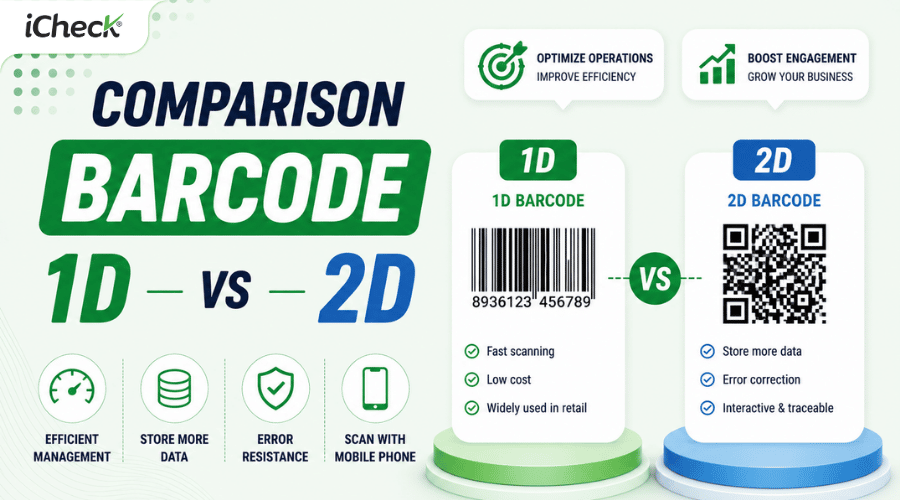
Both PDF417 and QR Code are 2D barcodes, but they differ in structure and usage:
Conclusion: PDF417 is ideal for applications that require storing a large amount of data, while QR Codes are more suitable for mobile devices and flexible, general-purpose use cases.
Is PDF417 free to use?
Yes. PDF417 is an open and royalty-free format, which means it can be used in any system without concerns about licensing or intellectual property infringement.
Can PDF417 store images?
No. PDF417 does not natively support image encoding.
However, images can be converted to binary data (compressed or encoded) before embedding into the barcode if needed.
That said, this method is not as efficient as using formats specifically designed for image storage.
Why is PDF417 less commonly used than QR Codes?
There are several reasons why PDF417 is less prevalent in mainstream applications:
Larger physical size, making it harder to fit on small packaging or labels.
Requires specialized 2D scanners, which are not as universally available.
In contrast, QR Codes are:
Easy to generate and scan with smartphones
Perfect for marketing, payments, and digital interactions
Conclusion
Thanks to its high data encoding capacity, robust error correction, and royalty-free licensing, PDF417 is an optimal solution for systems requiring secure and extensive data storage.
Although it requires compatible scanning devices and more space than some other barcode formats, PDF417 continues to be widely used in identity management, logistics, aviation, and manufacturing due to its reliability and flexibility.