
What Is a Location-Tracking QR Code? How It Works and Real-World Applications
Location-tracking QR codes are specialized QR codes designed to collect geographic data from users when they scan them. This type of QR code is particularly useful for businesses and organizations that want to gather location-based insights or deliver services tailored to specific locations. In this article, iCheckQR provides detailed information on how they work, how to implement them, and the benefits they offer.
What is a location-tracking QR code? How does it work?
A location-tracking QR code is a type of QR code that records a user’s location when they scan it—after permission is granted. When scanned, the code opens a link and requests access to the user’s location. The data is then sent back to the system for storage and analysis. This allows businesses to understand where customers are interacting in the real world, enabling more effective marketing and operations optimization.
QR codes do not automatically collect location data. When scanned, users are directed to a webpage. At this point, the browser requests permission to access the user’s location. If the user agrees, the system records the coordinates, scan time, and certain device information, then sends it to a server for storage and analysis. The entire process is quick but provides highly valuable data for understanding real-world user behavior.
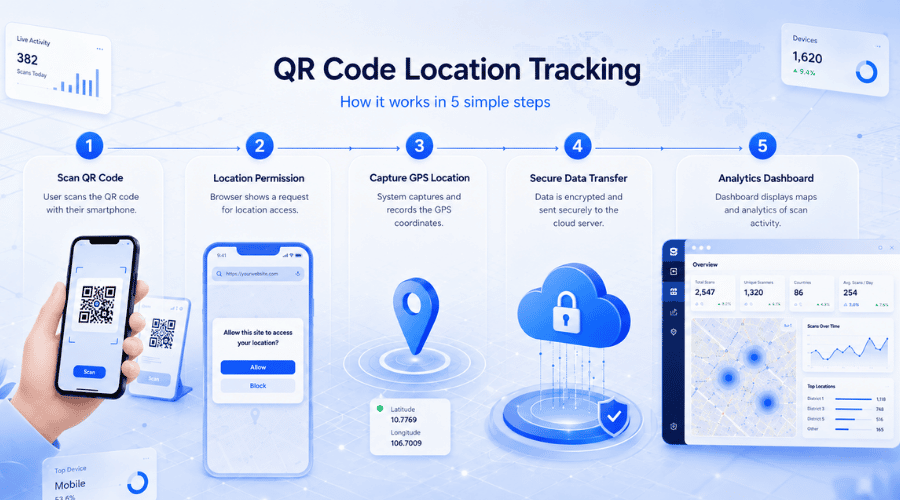 Workflow of a QR code system collecting GPS location data after user consent and displaying scan analytics on a real-time dashboard.
How to create a location-tracking QR code
Step 1: Prepare a URL → This is where location data will be received and stored when someone scans the QR code.
Step 2: Go to any QR code generator website → Paste your prepared URL → Download the QR code. At this stage, the QR code acts as a “gateway” to your link.
Step 3: When someone scans the QR code → Their phone opens your link, and the browser asks: “Allow access to location?”
Step 4: If they tap “Allow,” the system retrieves the latitude and longitude (this is the actual GPS location).
Step 5: Your website sends the data to the server and stores it in a database. For example: location, timestamp, and device information.
Step 6: You can review the recorded locations on a map or as a list of users who scanned the code.
Try iCheckQR now to create diverse, customizable QR codes tailored to your needs in just a few minutes!
Real-world applications of location-tracking QR codes
The value of location-tracking QR codes becomes most evident when applied in real-life scenarios.
In retail, businesses can identify which areas of a store attract the most customer interaction. Instead of relying on intuition, location data helps pinpoint “hotspots,” enabling better product placement and display optimization.
At events, location-tracking QR codes help organizers understand how crowds move. This is especially useful for adjusting layouts, allocating booths, or improving the attendee experience.
In tourism, QR codes can be placed at attractions to provide content tailored to specific locations. Users simply scan the code to receive information relevant to where they are, creating a more seamless experience.
In logistics, QR codes act as checkpoint markers. Each scan confirms the location of goods, helping track their journey accurately and reduce errors.
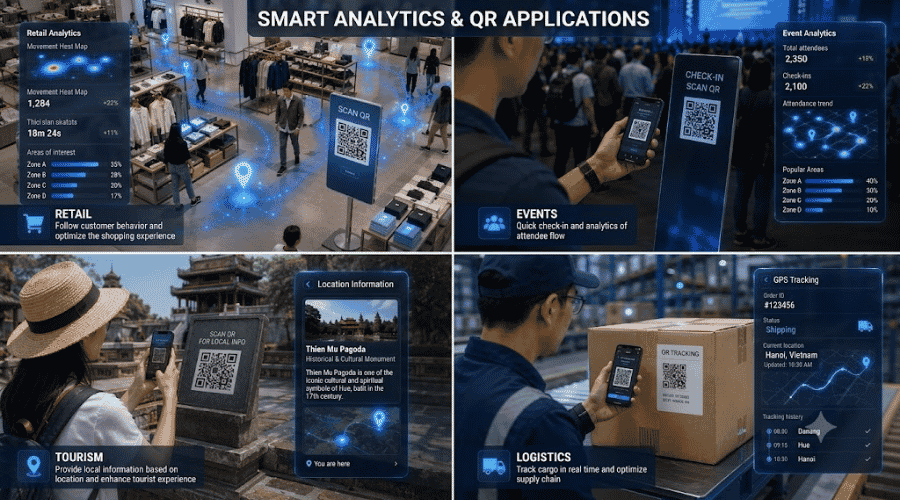 Real-world applications of location tracking QR codes across retail, events, tourism, and logistics industries.
Benefits of using location-tracking QR codes
The key advantage of location-tracking QR codes lies in their ability to turn offline behavior into measurable data. Businesses not only know whether customers interact, but also where and when those interactions occur.
As a result, operational and marketing decisions become more accurate. For example, in-store staff allocation can be based on actual traffic rather than estimates. Marketing campaigns can also be personalized by location instead of using a one-size-fits-all message.
Additionally, the user experience improves as content becomes more relevant to real-world context. This helps increase engagement and conversion rates.
Privacy considerations
Collecting location data always comes with responsibilities regarding security and transparency. Businesses must ensure that users clearly understand why their data is being collected and that they have the option to decline if they do not wish to share it.
A clear, easy-to-understand, and trustworthy permission request not only ensures compliance with regulations but also directly impacts user consent rates.
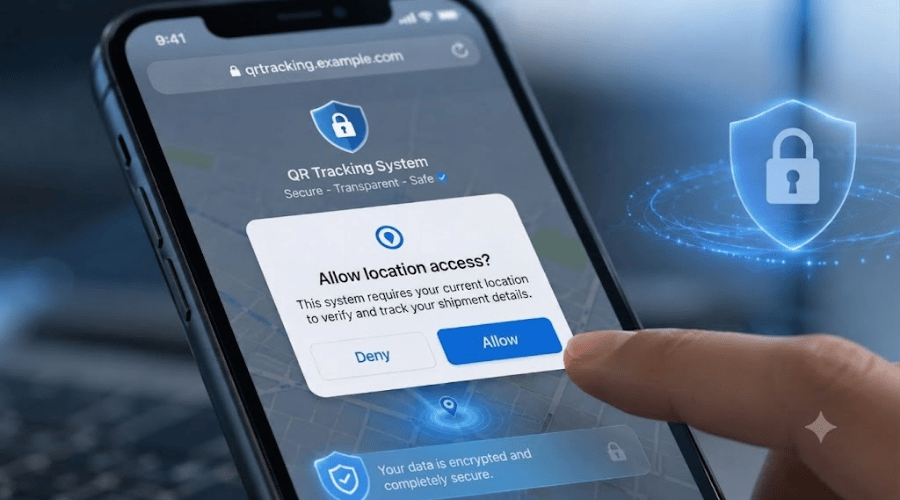 Privacy-focused QR tracking system with user consent and secure location data processing.
When should businesses use location-tracking QR codes?
Location-tracking QR codes are especially suitable for businesses with multiple offline touchpoints that want deeper insights into customer behavior in physical spaces. This includes retail chains, event organizers, logistics companies, and businesses in the tourism industry.
In a context where data is increasingly important, leveraging location information helps businesses not only track but also predict and proactively optimize user experiences.
Location-tracking QR codes are more than just a technological tool—they serve as a bridge between the offline world and digital data. When implemented correctly, they help businesses better understand their customers, operate more efficiently, and deliver experiences that are better aligned with real-world contexts.