
1D vs 2D Barcodes: What’s the Difference and Which Should You Use?
Both 1D and 2D barcodes identify and manage product data — but many businesses struggle to choose the right type when balancing internal operations, retail requirements, traceability, and customer-facing interactions.
Understanding the difference between the two helps you implement the right solution from the start, avoiding unnecessary costs and system overhauls down the line.
What Is a 1D Barcode?
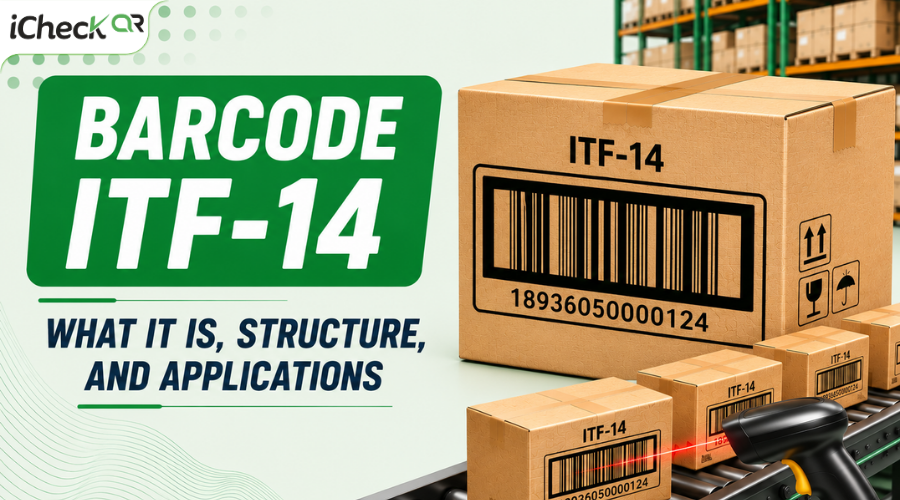
A 1D barcode or one-dimensional barcode uses parallel black and white bars to encode data in a single horizontal direction. It’s primarily used for product identification, inventory management, and retail operations. Common standards include EAN-13 for retail, UPC for North American markets, Code 128 for logistics, and Code 39 for internal and industrial use.
A scanner reads the bars horizontally and converts them into a character string, which the system then uses to retrieve product information from a database.
What Is a 2D Barcode?
A 2D barcode stores data across both horizontal and vertical axes, allowing it to hold significantly more information within the same physical footprint. It’s commonly used to link products to websites, documents, payment flows, or traceability systems. Most 2D formats also include error correction, so the code remains scannable even when partially damaged or obscured.
Popular 2D formats include QR Code for marketing, payment, and traceability; Data Matrix for manufacturing, healthcare, and electronics; PDF417 for documents, IDs, and transport; and Aztec Code for e-tickets and mobile applications.
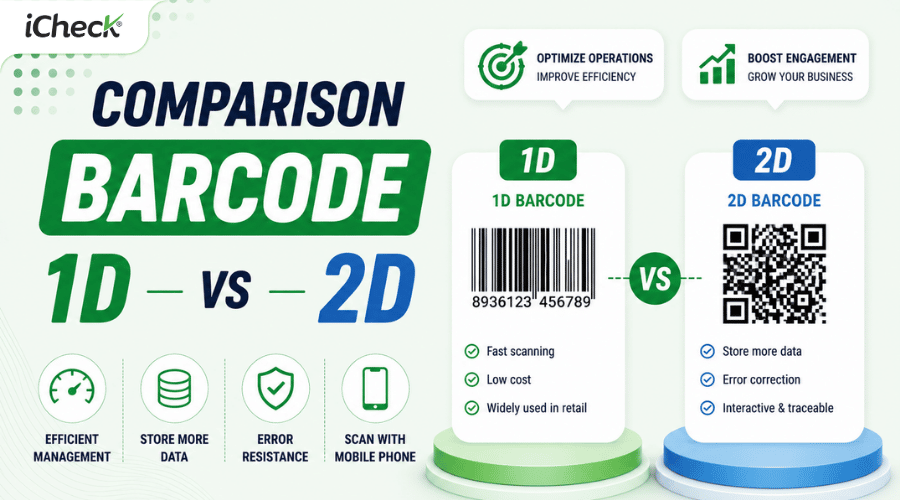
1D vs 2D Barcode: Detailed Comparison
The core difference between 1D and 2D barcodes isn’t just technical — it’s about what each type is designed to do in a real operational context.
1D barcodes suit retail and operational management thanks to fast scan speeds and low cost. 2D barcodes handle traceability, marketing, and digital interaction. Depending on your needs, you can use either independently or combine both.
When to Use 1D Barcodes
1D barcodes are the right choice when speed, stability, and compatibility with existing management systems are the priority. In retail, they let cashiers scan products quickly at POS. In warehousing and logistics, they support stocktaking, inbound/outbound recording, and inventory movement tracking — all with equipment most operations already have.
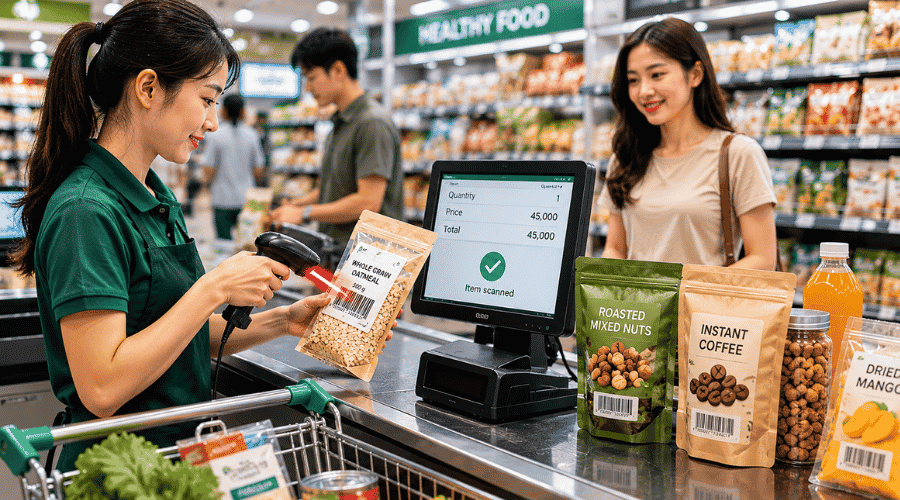 1D barcodes accelerate checkout and support inventory control across the supply chain.
When to Use 2D Barcodes
2D barcodes make sense when you want the code printed on a product to become a digital touchpoint with the customer. A single scan gives users access to product information, origin traceability, promotions, payment, or brand interaction — all from a smartphone, without any dedicated hardware on the customer side.
 2D barcodes let buyers access product information before making a purchase decision.
Should You Use Both?
In many cases, 1D and 2D barcodes don’t replace each other — they complement each other. A single product can carry a 1D barcode for sales, inventory, and supply chain movement, and a 2D barcode for traceability, product authentication, customer support, or marketing campaigns.
This combination is especially well-suited to FMCG, pharmaceuticals, cosmetics, food, retail, and manufacturing. The packaging then serves both internal operations and becomes a direct communication channel between the brand and the end consumer.
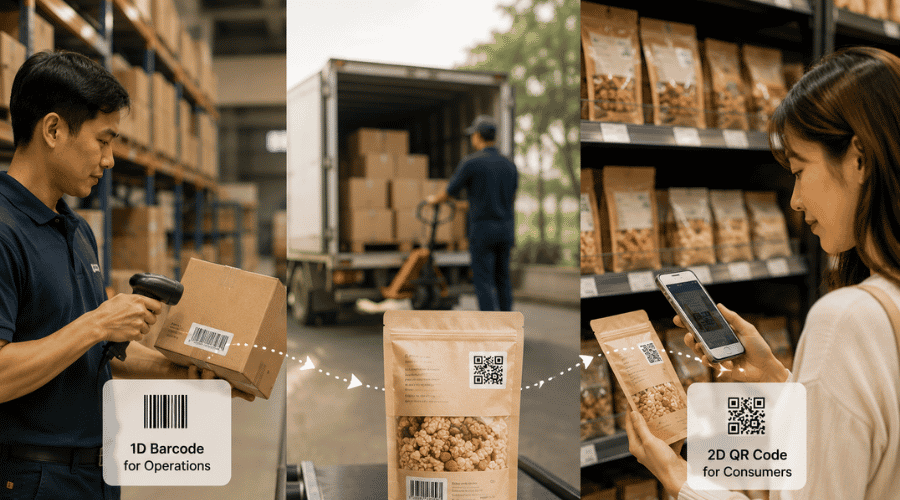 Combining 1D and 2D barcodes optimizes both operations and customer engagement.
Create 1D and 2D Barcodes Free with iCheckQR
Once you’ve identified the right barcode type, you can generate 1D or 2D codes online without any dedicated software. You can choose iCheckQR - a free online tool which supports online barcode creation and - best for inventory management, logistics, and retail. Additionally, this tool also has online QR Code generation feature - best for connecting products to websites, digital content, payments, or marketing campaigns
FAQ
How are 1D and 2D barcodes different?
1D barcodes read in one direction; 2D barcodes read in two, store more data, and support digital interaction.
Can 2D barcodes fully replace 1D barcodes?
Not yet. 1D remains well-suited for retail and logistics; 2D adds traceability, anti-counterfeiting, marketing, and payment capabilities.
When should you use a 1D vs. a 2D barcode?
1D for product management, inventory control, and POS checkout. 2D when you need to store more data or connect users to digital content in a single scan.
1D and 2D barcodes serve different purposes rather than replacing each other. 1D suits retail and operational management; 2D suits traceability, anti-counterfeiting, and digital interaction. Depending on your needs, businesses can use either type independently or combine both for maximum efficiency.