
What is QR Code? Definition, Applications, and a Complete A-Z Guide
Have you ever seen a black-and-white square on product packaging, at checkout counters, in brochures, or on event flyers and wondered: What is QR? What is a QR Code used for? How does a QR Code work? If so, you’re not alone. These are common questions. Today, QR Codes are a form of digital technology and have become a familiar part of everyday life.
In this article, iCheckQR will help you clearly understand what a QR Code is, its origin, structure, the difference between static and dynamic codes, and practical applications such as payment, information sharing, and marketing. Additionally, you’ll learn how to easily generate and scan QR Codes for free to make the most of this versatile tool.
1. How Is a QR Code Defined?
1.1. Definition
QR code is short for “Quick Response Code.”
It is a two-dimensional (2D) barcode capable of storing much more information than traditional barcodes. When scanned with a smartphone, a QR code can instantly open a website, display text, launch an app, connect to Wi-Fi, show an electronic business card (vCard), and more.

Illustration of a QR code
QR codes were invented in 1994 by engineer Masahiro Hara from Denso Wave (Japan). They were originally designed to track components in the automotive manufacturing industry.
1.2. Structure of a QR Code
Although a QR code may look like randomly arranged black-and-white squares, it is actually built on a very precise structure to ensure fast and accurate scanning. A standard QR code typically consists of the following components:
Positioning patterns: Three large squares located at three corners help the camera detect the position and orientation of the QR code, allowing accurate scanning even when the code is tilted or rotated.
Alignment patterns: Smaller squares distributed across the code, especially important for large QR codes. They help correct distortion when the code is curved, angled, or scanned from a distance.
Timing patterns: Alternating black-and-white modules running between the positioning markers. This pattern helps determine the size of each module and stabilizes the decoding process.
Data area: The region that contains all encoded information, such as a website link, text, phone number, or Wi-Fi configuration.
Error correction area: Allows the QR code to remain scannable even if it is partially damaged, blurred, or obscured.
Thanks to this structure, QR codes can be scanned quickly and reliably in most real-world conditions.

QR code structure and components
1.3. Key Characteristics
High data capacity: Stores text, URLs, phone numbers, emails, coordinates, payment data, and more.
Fast scanning: Information is read almost instantly with a camera.
Flexible size: Works well whether printed small or large.
Easy to print and share: Suitable for packaging, posters, screens, business cards, and more.
Error correction capability: Remains readable even when partially dirty, scratched, or covered.
1.4. How QR Codes Work
You can think of a QR code as an “information map” encoded using black-and-white modules. When a camera or QR scanning app recognizes these patterns, it decodes them into readable information displayed directly on your phone - such as opening a website, viewing content, downloading a file, or triggering an action.
In short: Camera → Pattern recognition → Decoding → Instant information display
2. Common Types of QR Codes
In practice, there are many types of QR codes, but the most common include:
Website (URL) QR codes: Open a web link when scanned; widely used in advertising, posters, and packaging.
Business card (vCard) QR codes: Display contact information and allow users to save it directly to their address book.
Wi-Fi QR codes: Enable Wi-Fi connection with a single scan, without entering a password.
Payment QR codes: Linked to bank accounts or e-wallets, widely used in retail and F&B.
Content QR codes (text, files): Display text or link to PDFs, images, digital menus, and more.

QR codes at a payment counter
3. Static QR Codes vs. Dynamic QR Codes
What Is a Static QR Code?
A static QR code contains fixed information. Once created, its content cannot be changed. If you need to update the link or data, you must generate a new QR code.
What Is a Dynamic QR Code?
A dynamic QR code allows you to update the content after the code has been created, without reprinting it. The QR code acts as a gateway, while the destination content is managed on a platform (for example, iCheckQR).
Differences Between Static and Dynamic QR Codes

Comparison between static and dynamic QR codes
4. How Is a QR Code Different from a 1D Barcode?
Both QR codes and 1D barcodes are used to store information, but they differ significantly in capacity and application.
A 1D barcode encodes data horizontally, so it can store only a small amount of information, usually a few numbers — suitable for basic retail and inventory management.
A QR code, on the other hand, is a 2D code capable of storing much larger amounts of data, including URLs, text, contact details, Wi-Fi settings, and linked images. It can still be scanned quickly even if partially damaged. This is why QR codes are widely used in payments, marketing, check-ins, information access, and digital transformation.
5. Common Ways to Scan QR Codes
You can scan QR codes in several ways, most of which are already available on smartphones without installing complex apps:
Using the phone’s camera: Open the camera → point it at the QR code → the phone automatically detects and displays the content.
Using Google Lens (Android & iOS): Open Google Lens via the Google app or camera → scan → view information.
Scanning with Zalo: Open Zalo → tap the “Scan QR” icon in the search bar → point the camera at the code.
Using dedicated QR scanner apps: Apps like QR Scanner or QR Code Reader are useful if you want to scan images or keep a detailed scan history.
Today, users can create QR codes using various methods, depending on their device and purpose.

User scanning a QR code with a smartphone
6. Common Ways to Create QR Codes
Today, users can create QR codes using various methods, depending on their device and purpose.
6.1. Creating QR Codes with Online Tools
The most common method is using online QR code generators such as ME-QR, Canva, iCheckQR, and others.
General process:
Choose the type of content to encode (URL, text, Wi-Fi, PDF, image, etc.)
Enter the data or upload a file
Customize the QR code design if needed
Download the QR code for use
This method requires no software installation and suits most users.

Examples of online QR code generators
6.2. Creating QR Codes with Mobile Apps
You can also create QR codes using QR generator apps on Android or iOS, such as ME-QR, QR Tiger, or QR Code Generator.
Basic steps:
Select the type of data to encode
Enter the content
Save or share the QR code directly from the app
This approach is convenient when you need to create and share QR codes quickly on your phone.
Additionally, on iPhones, users can create basic QR codes using the Shortcuts app. However, this method mainly supports simple use cases and offers fewer design and management options compared to dedicated QR code tools.
6.3. Creating QR Codes with Office (Word, Excel, PowerPoint)
For office users, QR codes can be created and inserted directly into documents using add-ins.
How it works:
Open a Word, Excel, or PowerPoint file → Home → Add-ins → search for “QR4Office” and install it
After installation, select “QR4Office” and enter the link or content to encode
The QR code appears in the document and can be resized, recolored, and saved
This method is suitable for documents, reports, and printed materials.

Creating a QR code in Excel
7. Real-World Applications of QR Codes
QR codes are widely used because they enable fast information sharing, reduce manual steps, and support many use cases, including:
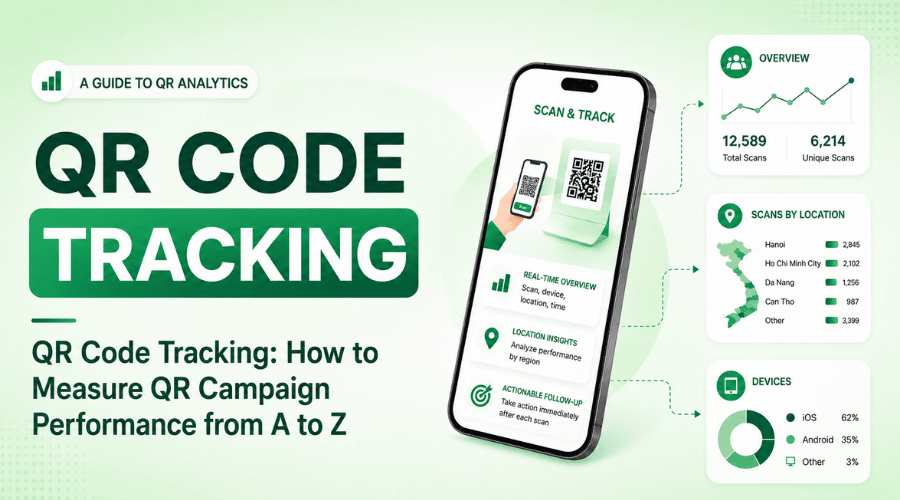
Marketing: Link to websites, promotions, or signup forms; track scans during campaigns
Payments: Enable cashless transactions and bill payments
F&B & Retail: Digital menus, product information, origin tracking
Education & Events: Access learning materials, quick check-ins, electronic tickets
Logistics: Track shipments and manage packages with QR codes

QR codes used in a promotional campaign
8. Frequently Asked Questions (FAQ)
Are QR codes safe?
Yes, but you should avoid scanning codes from unknown or untrusted sources to reduce the risk of malicious links.
Does scanning a QR code cost money?
No. Scanning QR codes is completely free on smartphones.
Do QR codes expire?
It depends on the type. Static QR codes usually do not expire, while dynamic QR codes depend on the platform used.
Do I need internet access to scan a QR code?
Yes, if the code links to a website or online content. No internet is needed if the QR code only displays offline text.
Conclusion
QR codes have become a familiar tool thanks to their flexible data storage, ease of creation and scanning, and wide applicability across fields such as marketing, retail, education, and payments. With various formats and use cases, QR codes make information sharing and access faster and more convenient in today’s digital world.