

5 QR Code Campaigns That Increased Customer Engagement (+ Key Takeaways)
Is your QR code campaign driving conversions or are users just scanning and leaving? Many businesses face the same problem: users scan the code, spend a few seconds on the landing page, then leave without taking any action. An effective QR code campaign should go beyond the scan — it needs to hold attention, drive engagement, and guide users toward a clear conversion goal.
The 5 campaigns below show how major brands turned QR codes into tools for boosting engagement and real business results.
What is a QR Code Campaign?
A QR code campaign is a marketing initiative that uses QR codes as a touchpoint to bridge the offline and online worlds, guiding consumers toward a specific objective — whether that's driving traffic, capturing leads, generating app installs, activating promotions, or accelerating sales.
A QR code on its own is simply a tool. A standalone code typically functions as little more than a hyperlink. A complete campaign, however, is built around:
A clearly defined goal
A specific, compelling CTA
A mobile-optimised landing page
Scan data tracking
A post-scan conversion strategy
5 Real-World QR Code Marketing Campaign Case Studies
The following campaigns represent some of the most instructive examples of how QR codes have reshaped marketers' understanding of what this format can achieve.
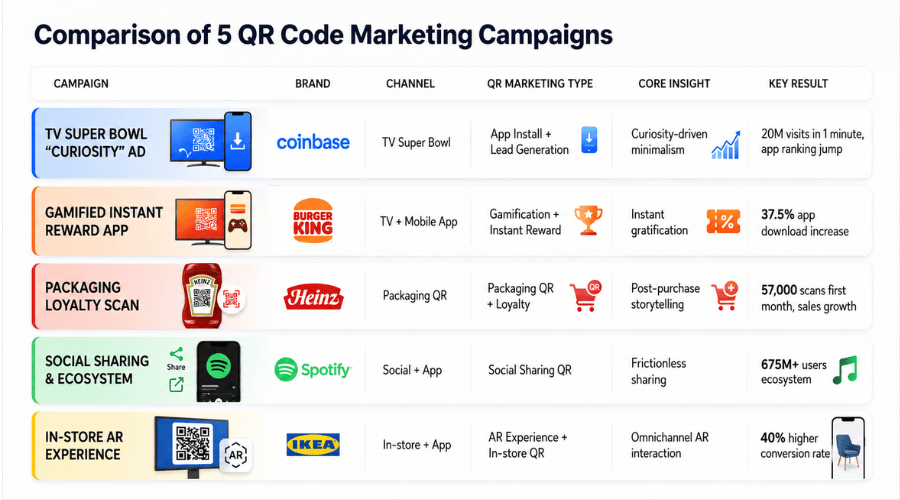 These 5 QR Code campaigns demonstrate how each brand leverages QR codes in a completely different way, depending on the channel and objective.
Case 1: Coinbase Super Bowl QR Campaign (2022)
On February 13, 2022, during Super Bowl LVI, Coinbase aired a 60-second commercial with no voiceover and no celebrity endorsements — just a colourful QR code bouncing across a black screen, reminiscent of a DVD screensaver. Scanning it led to a landing page offering new users $15 in free Bitcoin, and existing users the chance to enter a $3 million crypto giveaway.
Results:
Over 20 million visits to the landing page within a single minute, according to Coinbase's CPO
The Coinbase app climbed from #186 to #2 on the Apple App Store on the same day
App downloads increased 309% compared to the prior week
Engagement reached 6x the brand's historical average
The website went down for approximately 63 minutes due to server overload — and the outage itself became part of the viral narrative
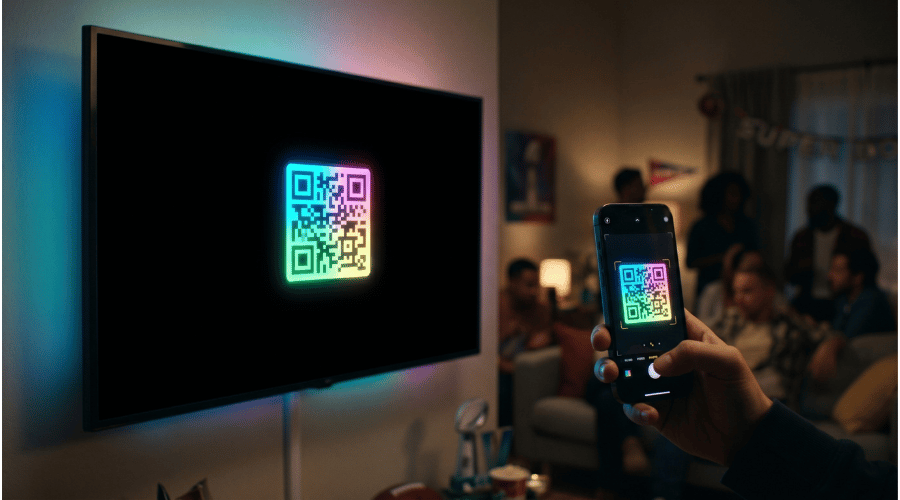 The QR code acts as an “information gap” that triggers curiosity, turning scanning into an instinctive discovery behavior rather than a typical ad response.
Insight: Minimalism generates curiosity. When viewers encounter something unfamiliar, they instinctively want to understand it. In the context of a high-trust event like the Super Bowl, a mysterious QR code proved far more compelling than a fully explained advertisement.
Key Takeaways:
Curiosity can outperform over-explaining when used in the right context
The value after the scan matters more than the QR code itself
Faster landing pages often convert better than heavily tracked experiences
Case 2: Burger King QR Whopper & Whopper Detour Campaign (2019–2020)
Burger King ran two standout QR code campaigns during this period. In 2020, amid COVID-19 lockdowns, the brand launched the QR Whopper campaign: a QR code logo bounced across TV screens, and viewers who scanned it immediately received a free Whopper coupon via the Burger King app.
The Whopper Detour (2019) took a more provocative approach — using geolocation to unlock a 1-cent Whopper coupon when users were standing near or inside a McDonald's, then redirecting them to the nearest Burger King to redeem it.
Results:
The BK app was downloaded over 1.5 million times in just 9 days
Downloads increased 37.5%, ranking #1 on both the Apple App Store and Google Play
Mobile order value increased 300% during the campaign period
Redemption rates were 40x higher than the brand's previous digital coupon record
Final ROI: 37:1, with mobile sales sustaining at 200% above pre-campaign levels even after the campaign ended
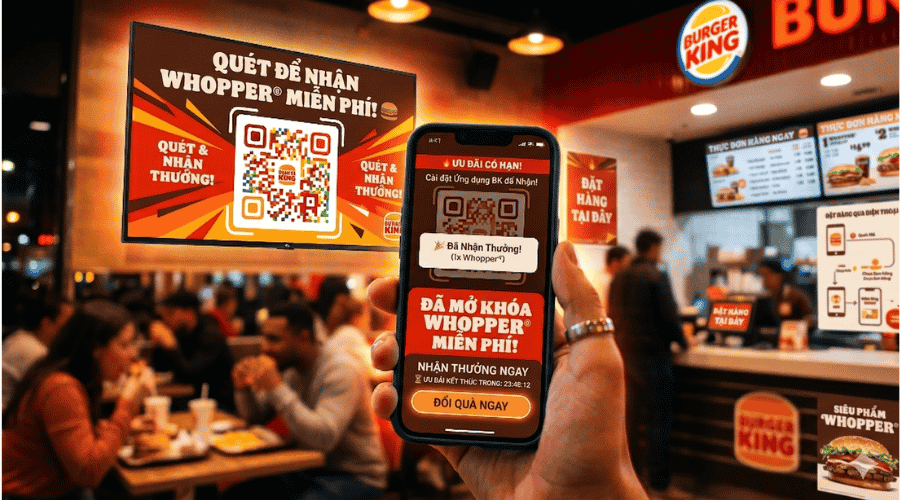 The campaign combines gamification with limited-time rewards, making QR scanning feel competitive and urgency-driven.
Insight: Instant gratification is the strongest motivator for scanning. Consumers don't want to "learn more" — they want an immediate, tangible reward. Gamification elements (only 10,000 Whoppers available, time-limited redemption) added urgency that pushed intent to action.
Key Takeaways:
An immediate post-scan reward outperforms product information — people scan for what they'll receive, not what they'll see
Scarcity and time limits convert passive interest into immediate action
App install campaigns perform best when paired with an exclusive first-time-use offer
Case 3: Heinz QR Packaging Campaigns (2011–2019)
Heinz is among the earliest and most consistent adopters of QR codes on product packaging in the FMCG sector. The brand ran at least three distinct QR code marketing campaigns on its restaurant ketchup bottles:
"Guess What We Just Planted" (2011–2012): QR on bottle → a prize wheel landing page with eco-friendly rewards. Each scan prompted Heinz to plant one tree in partnership with The Nature Conservancy. Result: over 1 million scans.
"Wounded Warrior" (2012): QR → a personalised thank-you card generator for veterans. Heinz donated $0.57 per scan to the cause.
"Get Well Soup" (2019, UK): QR on soup tins → a custom "get well soon" card builder. Result: 500,000 scans in two months; soup sales increased 12%.
In the original PlantBottle campaign, the first month recorded 57,000 scans, with ketchup sales rising 30% during the same period.
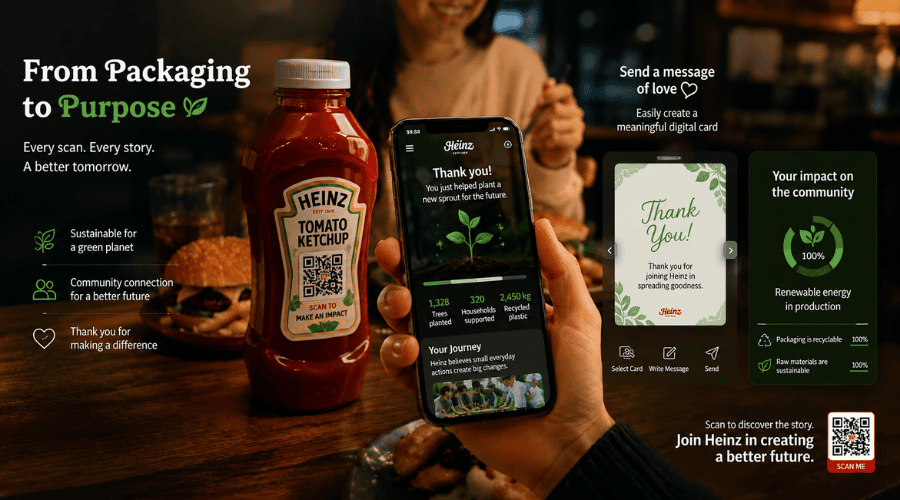 The campaign leverages moments when customers are actively using the product to drive more natural and less intrusive brand engagement.
Insight: Product packaging is one of the most undervalued touchpoints in the customer journey. Consumers handling a product — waiting for food, eating a meal — are relaxed and unguarded. A QR code that leads to an emotionally resonant experience, such as planting a tree or sending a card, connects naturally with that mindset.
Key Takeaways:
Packaging QR codes perform better with emotional experiences, not simple product links
Post-purchase moments create stronger opportunities for customer engagement
Social causes and community-driven campaigns can boost scans and sharing
Case 4: Spotify Codes — Frictionless Music Sharing (2017–Present)
In 2017, Spotify introduced Spotify Codes — a proprietary scan format shaped like a soundwave, designed to be scanned directly through the in-app camera. Rather than a single campaign, this was a platform-level feature. Any user could generate a code for a playlist, track, album, or artist page and share it as an image.
During the COVID-19 period (2020–2021), sharing playlists via Spotify Codes on Instagram Stories became widespread, transforming music sharing into a natural social behaviour.
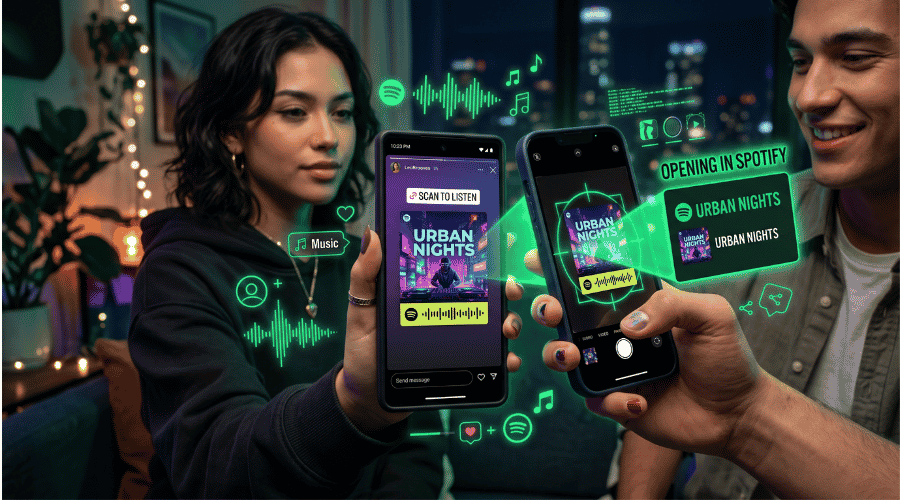 Spotify Codes transform music sharing into a form of self-expression and identity rather than simply sending links.
Insight: Gen Z and Millennials value personalisation and immediacy — a playlist is an expression of identity. Spotify Codes transformed the act of "sending a link" into something more aesthetic and intuitive, making music sharing feel personal rather than transactional.
Spotify's sharing flow: User creates playlist → Generates Spotify Code → Posts to Story → Friend scans → Listens immediately in-app
Key Takeaways:
QR codes are most powerful when they eliminate a genuine point of friction — not by adding a feature, but by shortening a journey
Design the QR format as part of your brand identity — Spotify Codes use a distinctive soundwave shape rather than a standard black-and-white QR code
This logic applies broadly: restaurant menus, loyalty cards, product review prompts
Case 5: IKEA Place App + QR In-Store Campaign (2017–Present)
IKEA Place launched alongside Apple's ARKit, allowing customers to scan QR codes in catalogues or in-store to virtually place true-to-scale furniture in their own spaces. IKEA subsequently expanded its QR usage to link to product videos, assembly instructions, reviews, and digital content — turning every physical touchpoint into a gateway to an enriched digital experience.
Results:
The AR experience within IKEA Place delivered a 40% increase in conversion rates
Customer satisfaction scores rose 15% in stores integrating digital tools such as in-store QR codes
IKEA Place became the most downloaded non-gaming AR app at the time of its launch
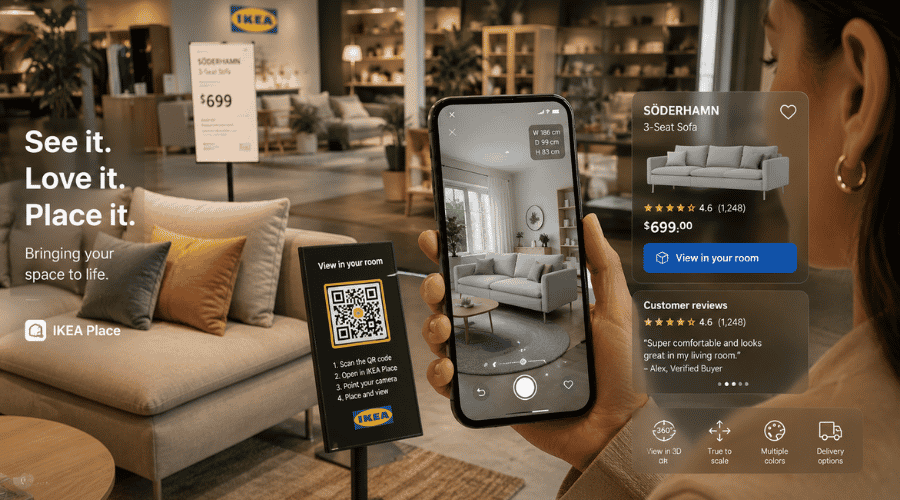 The QR-powered AR experience makes the buying journey more interactive, increasing confidence before making a purchase decision.
Insight: Furniture purchasing is a high-consideration decision — consumers fear making the wrong choice. AR allows them to visualise a product in their actual space, and the QR code is the trigger that unlocks that experience.
Key Takeaways:
QR codes work best when they make the buying experience more interactive
In-store QR scans are most effective at high-intent moments near the product
One QR code can support multiple goals, from product info to AR demos and app downloads
What High-Performing QR Campaigns Have in Common ?
A Clear, Value-Oriented CTA
Low scan rates are almost always a result of consumers not understanding why they should scan. Effective CTAs communicate what the user will receive, not just what they should do. "Scan to learn more" is inert. "Scan to claim $15 in Bitcoin," "Scan to plant a tree," or "Scan to see this sofa in your living room" are actionable.
Immediate Value Delivery
Eliminating friction between the scan and the reward is non-negotiable. Long forms, slow loading times, and unnecessary redirects erode conversion rates. The strongest-performing campaigns deliver clear, tangible value the moment the scan is complete.
Curiosity or Reward — Ideally Both
Coinbase leveraged curiosity; Burger King and Heinz focused on tangible rewards. Strong campaigns typically employ at least one of these levers. Exceptional campaigns combine both. A strategically mysterious QR code, placed in the right context, is one of the most effective ways to activate this dynamic.
Fast Mobile Experience (Load Time Under 3 Seconds)
QR traffic is inherently mobile-first, and often comes from users who are on the move or standing in a physical environment. The speed threshold is stricter here than for other traffic sources.
A Natural Offline-to-Online Transition
Users scan in a specific physical context — watching television, holding a ketchup bottle, standing in front of a sofa. The post-scan landing page must acknowledge and connect to that context, rather than restarting the journey from scratch. Continuity increases conversion.
FAQ
Q: How do you measure the effectiveness of a QR code campaign?
Use dynamic QR codes to track scan volume, time, location, and device. Attach UTM parameters to measure deeper on-site behaviour in Google Analytics — including conversion rate, bounce rate, and time on page.
Q: Which industries are best suited to QR marketing?
Food & Beverage, Retail, and FMCG are the most natural fits. However, any sector that needs to shorten the path from awareness to action — including Real Estate, Education, and Healthcare — can run effective QR code campaigns.
Q: What does a QR campaign cost to run?
Costs vary considerably. A basic campaign can be launched for well under $250. The primary ongoing expenses are a dynamic QR management platform (typically around $15/month) and the quality of your landing page.
Q: Do QR codes actually work for marketing?
Yes — when designed correctly. The limitation is rarely the QR code itself. It lies in whether the CTA is compelling enough to prompt a scan, and whether the landing page is fast and focused enough to retain the visitor once they arrive.
Conclusion
These five campaigns demonstrate that QR codes are capable of far more than functioning as a standalone advertisement. From loyalty programmes and event check-ins to digital menus and post-purchase experiences — each example represents a fundamentally different application of QR code marketing. If you'd like to explore how these principles apply to a specific industry or business context, further reading on practical QR code marketing applications is a useful next step.